Gamma: When Paying Users Switch Off the Growth Engine
Why it matters: Every upgrade quietly turns one growth channel off
HypothesisAs more users pay, the viral loop gets weaker exactly where viewers are most valuable: clients, executives and buyers seeing business decks.
In 30 seconds
- The company: Gamma, an AI tool that turns a prompt into a presentation. It reached $100M ARR, profitably, with about 70M users.
- What everyone says: every shared deck carries a "Made with Gamma" badge, so every deck is free marketing.
- What they miss: paying for Gamma removes that badge. The decks most likely to reach business buyers are the ones that stop advertising.
- My metric: the share of deck views that show no badge, and what a viewer of a paid user's deck is worth.
The thinking, drawn
3 diagrams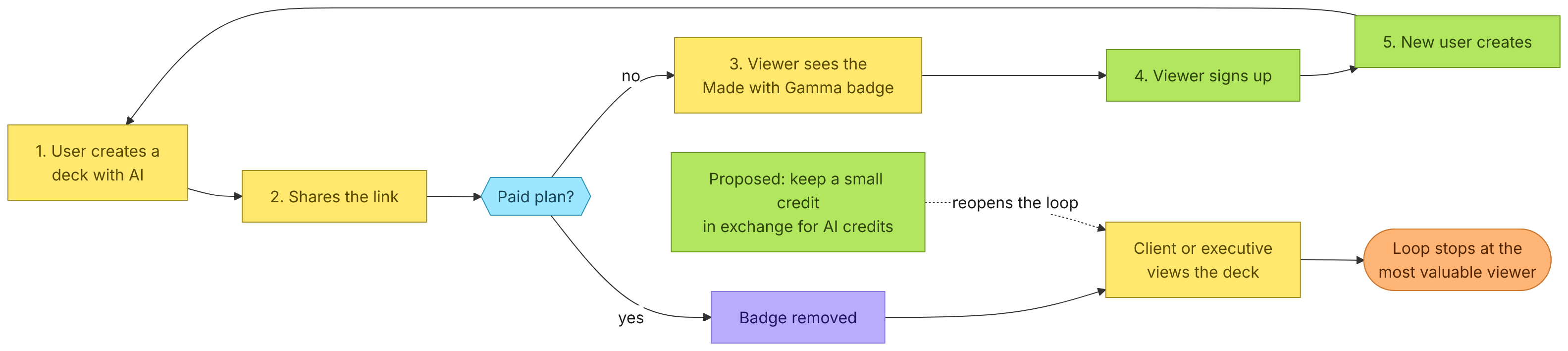

How I'd Test It
- Measure the gap. Compare sign-ups per 1,000 views on free decks vs. paid decks that keep the badge on. Estimate Gamma doesn't publish this. My guess is that viewers of business decks convert to paid at a higher rate, even if fewer sign up.
- Offer a trade, not a removal. Let paid users keep a small, tasteful credit ("Built with Gamma") in exchange for extra AI credits for every sign-up it brings.
- Run it as an A/B test for 4 weeks on new Plus subscribers. Success means more paid sign-ups per 1,000 paid-deck views, with no rise in Plus cancellations.
The best growth question isn't "what drives sign-ups?" It's "what does our pricing quietly switch off?"
The full deep dive
For interviewers who want every detail and source.
More on the signal
The tension in one line: Gamma's monetisation and its growth engine pull in opposite directions. Removing the badge is a top reason people upgrade for client-facing decks, and client-facing decks reach the audience most likely to pay.
What's Public
- Gamma reports $100M+ ARR, reached profitably, with 70M+ users and a team of around 50.
- Growth came mostly from word of mouth, with the badge on shared decks turning viewers into users.
- The free plan shows the badge on every share and export. Plus and above remove it.
- At the 50M-user mark, Gamma reported about 600,000 paying subscribers, roughly 1.2% of users.
Why It Could Be Wrong
If paid users mostly share decks internally with colleagues who already use Gamma, the badge-off views cost almost nothing. That's the first thing the measurement would show.
PM Deep Dive
The growth model: a viral loop with a leak
Gamma's loop is simple: a user creates a deck, shares it, someone views it, sees the badge, and signs up. Its strength can be expressed as a viral coefficient (K-factor):
K = views per deck × share of viewers who sign up × share of new users who go on to create and share
When K is above 1, each user brings in more than one new user, and growth compounds on its own. Removing the badge sets the middle term to zero for every paid deck. So each upgrade quietly takes one user out of the loop.
Monetisation design matters as much as virality
Sacra's comparison makes the point: Tome reached 25M users with an almost entirely free product and only about $3.5M ARR, while Gamma made about $20M ARR from 40M users using a credit-based freemium model. Virality brings users; pricing design decides whether they ever pay.
Metric tree
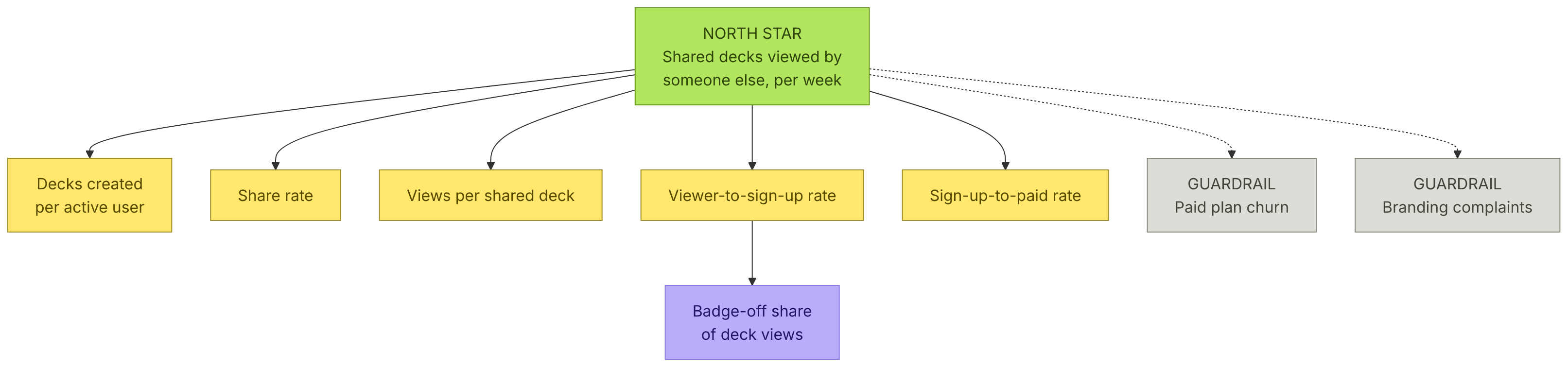
- North Star: shared decks viewed by someone other than the creator, per week.
- Input metrics: decks created per active user, share rate, views per shared deck, viewer-to-sign-up rate, sign-up-to-paid rate.
- Guardrails: paid plan churn, and complaints about branding on paid decks.
Experiment design
- Hypothesis: if paid users can keep a subtle credit in exchange for AI credits, paid-deck viewers will generate more paid sign-ups, because they see Gamma used for real business work.
- Randomisation unit: the paying user, not the viewer. Randomising viewers would let the same deck show both versions, contaminating the result.
- Primary metric: paid sign-ups attributed per 1,000 paid-deck views. Attribution uses a tracking parameter on the badge link, so every sign-up is tied to the deck that brought it.
- Guardrails: Plus churn and opt-out rate.
- Duration: at least four weeks, long enough to cover a full cycle of decks being created, shared and viewed.