Google Stadia: The Technology Worked. The Math for Players Didn't.
Evidence: Stadia: buy it at full price. Game Pass: included in one monthly fee.
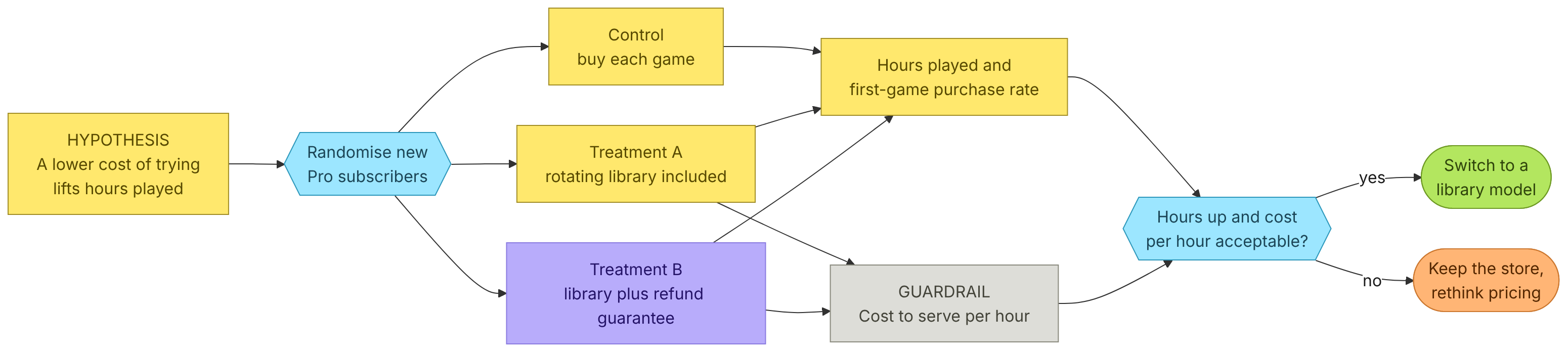
HypothesisStreaming made playing frictionless, but buying stayed as expensive as on a console. Players compared the cost of trying, not the technology, and stayed where trying was free.
In 30 seconds
- What happened: Stadia streamed console-quality games from Google's cloud with no console needed. It launched in November 2019 and shut down in January 2023, with full refunds.
- The usual explanation: not enough games.
- My read: the game library was a symptom. The real problem was the cost of trying anything. Stadia asked players to pay full price per game on a new platform, while rivals let them try hundreds of games for one monthly fee.
- The number: Google never shared player counts. Its own reason for shutting down was that Stadia hadn't gained the traction with users it expected.
The thinking, drawn
3 diagrams

What I'd Have Done Differently
- Lead with a library, not a store. Launch with a subscription catalogue so the first game costs nothing extra, the way Game Pass did.
- Track first-game purchase rate among Pro subscribers. If people who already pay monthly won't buy a single game, the store model isn't working. Estimate this rate was likely low. Google never published it.
- Remove the trust risk upfront. Promise refunds or cross-platform saves from day one if the service ever closes. That makes buying a game a safe decision, not a gamble.
Removing friction from using a product doesn't help if you leave all the friction in deciding to try it.
The full deep dive
For interviewers who want every detail and source.
More on the signal
There was a second, quieter cost: trust. Buying a game means betting the platform will still exist in five years. My hypothesis is that many players weren't willing to make that bet on a brand-new Google product. In the end, Google's full refunds were generous, but they arrived after the bet was already lost.
What Happened
- Nov 2019: launched. A Pro subscription gave a few games each month, but most games had to be bought separately at full price.
- Feb 2021: Google closed its in-house game studios. Bloomberg reported Stadia had missed its user targets by hundreds of thousands, and Google lowered its subscriber goals.
- Meanwhile: Xbox Game Pass offered a large library plus cloud streaming for one monthly fee.
- Sept 2022: Google announced the shutdown, refunding all hardware and game purchases. Service ended on January 18, 2023.
PM Deep Dive
Diagnosis: a two-sided cold-start problem
Stadia was a platform with two sides. Players wanted games before joining, and publishers wanted players before investing in games. With neither side committed, each waited for the other. Google's own studios were meant to break the deadlock, and closing them in February 2021 removed the only lever Stadia controlled.
Technology: why supply was expensive
- Stadia ran games on Linux servers in Google's data centres, using the Vulkan graphics API. Most games were built for Windows or consoles, so publishers had to port each title, an extra cost for a small audience.
- Cloud gaming is very sensitive to latency: the delay between pressing a button and seeing the result. Experience depended on the player's home connection, which Google couldn't control.
- Every hour played costs server time, so heavy players were the most expensive users, unlike a console, where the player has already bought the hardware.
Pricing: two-part tariff vs. all you can eat
Stadia used a two-part tariff: a Pro subscription plus full price per game. Xbox Game Pass used an all-you-can-eat library. A two-part tariff works when the platform is already trusted and essential; for a new platform it doubles the decision a player has to make.
Metric tree
- North Star: weekly hours played.
- Input metrics: games tried per player, first-game purchase rate among Pro subscribers, stream session success rate (sessions without noticeable lag).
- Guardrail: cost to serve per hour played.
Platform risk as a product feature
Buying a game is a bet that the platform survives. Reports at the time noted that Google's history of closing services weakened developer confidence. The fix is to price the risk in: guarantee refunds or cross-platform saves upfront, which turns a perceived weakness into a reason to try.