Koo: Growth That Was Rented, Not Owned
Evidence: Monthly users fell by about two-thirds within about nine months of Koo halting campaigns
HypothesisKoo's users came for VIPs and news moments, not for each other. With no reason to return, growth lasted only as long as the spending.
In 30 seconds
- What happened: Koo, India's homegrown Twitter alternative, raised over $50M, reached about 10M monthly users, and shut down in July 2024.
- The usual explanation: the funding winter.
- My read: funding ran out because the product never earned its own growth. Users arrived on news events and paid campaigns, and left when both stopped.
- The number that showed it: monthly users fell by about two-thirds within roughly nine months of Koo stopping user acquisition campaigns.
The thinking, drawn
3 diagrams

What I'd Have Done Differently
- Measure who talks to whom, not just who shows up. A social network survives on conversations between ordinary users. I'd have tracked the share of active users who reply to or follow non-VIP users. Estimate it was likely low, because Koo's draw was VIPs broadcasting. Koo never published this.
- Pick one community and win it completely. Regional languages were Koo's real edge. Owning one language community fully, before spending on national campaigns, builds growth that doesn't need paying for.
- Test retention before scaling spend. Pause paid campaigns in one region for a month. If users vanish there, the product isn't ready to scale.
Event-driven growth feels like product-market fit. The test is what happens when you stop paying for it.
The full deep dive
For interviewers who want every detail and source.
More on the signal
The money side tells the same story. In FY22, Koo reported operating income of just ₹14 lakh against a loss of ₹197 crore. Near-zero revenue meant every user had to be bought, and the funding winter made that impossible.
What Happened
- 2020: launched in March; became a top news app in India within months.
- 2021: the government's dispute with Twitter brought ministers and VIPs onto Koo. It peaked at about 2.1M daily and 10M monthly users, with 9,000+ VIP accounts.
- June 2022: Koo halted user acquisition campaigns. By then it had raised over $50M at a peak valuation of $285M.
- July 2022 to April 2023: monthly users fell from 9.4M to 3.1M.
- June 2023 to Feb 2024: active users fell from 7.2M to 2.7M, a 62% drop (data.ai).
- July 2024: buyout talks with Dailyhunt failed and Koo shut down.
PM Deep Dive
Diagnosis: a network that never had its own core
Social products need network effects: each new user makes the product more valuable for everyone else. That only starts once there's a small, dense group of ordinary users who come back for each other. Koo's growth came from VIPs broadcasting during news moments. My read is that this gave it celebrities and an audience, but few conversations between ordinary users. Koo never published that split, so treat it as a hypothesis.
Unit economics
- FY22 operating income was ₹14 lakh against a ₹197 crore loss, so revenue per user was close to zero.
- With near-zero lifetime value (LTV), any customer acquisition cost (CAC) is unrecoverable. The LTV-to-CAC ratio couldn't work at any scale.
- That's why halting acquisition in June 2022 was decisive: there was no organic engine underneath to take over.
Metric tree I'd have run
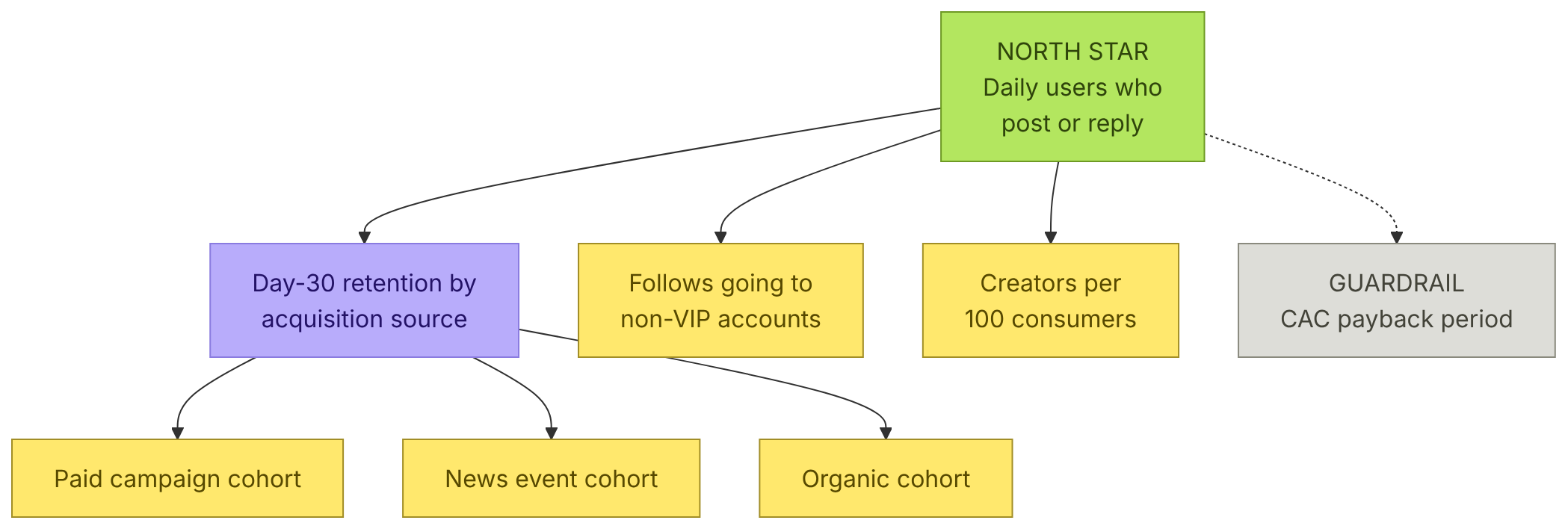
- North Star: daily users who post or reply, not just scroll.
- Input metrics: day-1, day-7 and day-30 retention by acquisition source; share of follows going to non-VIP accounts; creators per 100 consumers.
- Guardrail: CAC payback period.
The analysis that would have warned them
Plot retention curves by cohort, split by how users arrived: paid campaign, news event or organic. A healthy product's curve drops, then flattens. If the paid and event cohorts decayed toward zero while only organic flattened, the growth was being bought, not earned.
Experiment: geo holdout
Pause paid campaigns in a few matched regions for 4 weeks and compare active users against regions where spending continued. The gap is the true incremental effect of paid acquisition, and what's left is the organic base.