
Jar: The Day the Auto-Save Fails
Why it matters: Daily savings is the hero feature, and revenue grows with every successful purchase of gold
HypothesisA failure doesn't just lose one day's saving. It breaks the streak and makes saving feel like something that can go wrong, so many users pause or cancel within days. Each lost daily saver means losing hundreds of future transactions a year.
In 30 seconds
- The company: Jar, an Indian app that auto-saves as little as ₹10 a day into digital gold using UPI AutoPay. It has about 35M users, made ₹208 crore in operating revenue in FY25, and turned profitable in the second half.
- What everyone measures: sign-ups, daily savers, money saved.
- What they miss: a daily auto-save will eventually fail, usually because the user's balance is low that day. That moment, not sign-up, decides whether the habit survives.
- My metric: of users whose auto-save fails for the first time, how many are still saving 30 days later.
The thinking, drawn
3 diagrams

How I'd Test It
- Find the cliff. Compare 30-day survival for users who've never had a failure against users in their first week after one. Estimate I expect a sharp gap. Jar doesn't publish this.
- Change what a failure feels like. Instead of a failed payment, call it a "rest day," and offer a one-tap catch-up the next day.
- A/B test it on new daily savers for 6 weeks. Success means higher 60-day survival after a first failure, with no rise in complaints about surprise debits.
For habit products, the most important moment isn't the first success. It's the first time something goes wrong.
The full deep dive
For interviewers who want every detail and source.
What's Public
- Jar uses UPI AutoPay to run daily or weekly savings, starting at ₹10 a day.
- Its founder calls daily savings the app's hero feature, the one most users come for.
- Jar reported ₹208 crore operating revenue in the year to March 2025, turning profitable in the second half, with around 35M users.
- Jar worked with PhonePe on two fixes for failed auto-debits: a notice before each debit so users keep enough balance, and automatic retries. PhonePe's case study reports payment success rates up by as much as 15%.
That last point matters: Jar has already shown failed auto-saves are a big enough problem to engineer around. What's not public is what happens to the user after a failure.
Why It Could Be Wrong
If most users who hit a failure were already about to stop, the failure is a symptom, not the cause. Comparing users with similar saving history before the failure separates the two.
PM Deep Dive
The habit loop
Daily saving is a habit product. It runs on a loop: a trigger (the daily debit), an action (the money moves), a reward (the gold balance grows, the streak extends) and an investment (the more you've saved, the more you want to protect it). A failed debit breaks the loop at the reward step, and loss aversion makes a broken streak feel worse than the money involved.
Technology: how UPI AutoPay works, and where it fails
- The user authorises a recurring mandate once; Jar then debits on schedule without the user approving each payment.
- Under RBI rules for recurring payments, the user must get a pre-debit notification before each debit. That's the notice Jar and PhonePe used to warn users to keep enough balance.
- A debit can fail for different reasons: low balance, a bank-side technical decline, or the user revoking the mandate. Each needs a different fix: reschedule, retry automatically, or win the user back.
Voluntary vs. involuntary churn
Subscription businesses split churn in two. Voluntary means the user chose to stop. Involuntary means a payment failed and the user drifted away without ever deciding to leave. My hypothesis is that a large share of Jar's lost daily savers are involuntary, and involuntary churn is the cheapest kind to win back.
Metric tree
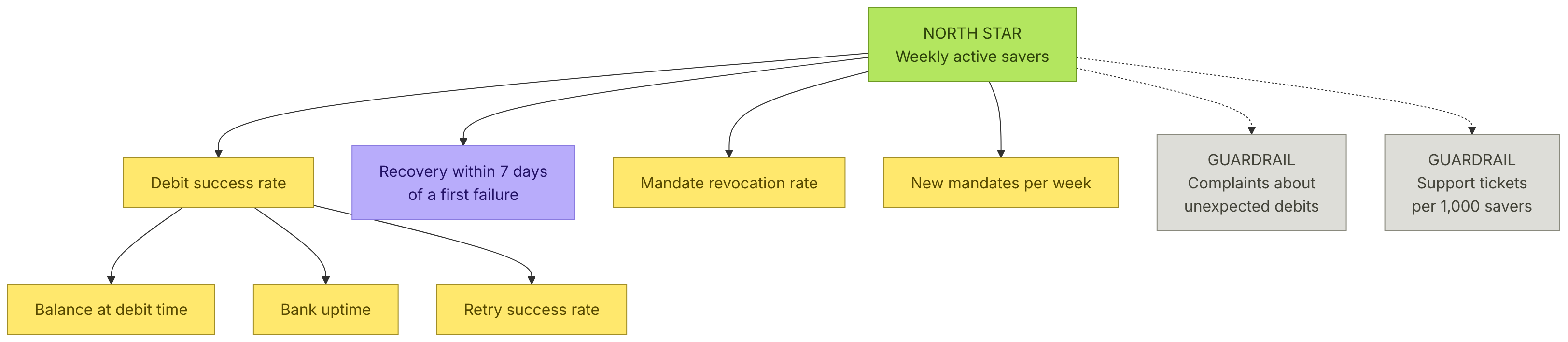
- North Star: weekly active savers, users with at least one successful auto-save that week.
- Input metrics: debit success rate, recovery rate within 7 days of a first failure, mandate revocation rate.
- Guardrail: complaints about unexpected debits. A catch-up debit that surprises users would destroy trust faster than a missed day.
Analysis and experiment
- Survival analysis: plot a survival curve (Kaplan–Meier) of time until a user stops saving, comparing users with and without a first failure. The gap between the curves is the cost of the failure moment.
- Experiment: randomise at the user level among first-time failures. Control sees today's failure message; treatment sees a "rest day" with a one-tap catch-up.
- Primary metric: share of users still saving 60 days after their first failure.
- Split the results by failure reason, since a low-balance failure and a bank decline need different treatment.