Knit PM: The Problem Most PMs Said Can't Be Solved
HypothesisMisalignment shows up as decisions that come back after everyone "agreed." If Knit PM works, that number drops.
In 30 seconds
- Problem: PMs lose weeks to stakeholders who say yes in the meeting and push back later.
- What I did: interviewed 25 PMs and project managers, repositioned the product from a general PM workspace to a stakeholder alignment tool, and built a working demo.
- What I found: about 15 of 25 said the problem is real. Most also said it can't be solved.
- Where it stands: working demo, no paying customers yet. The demo exists to test whether they're wrong.
The thinking, drawn
3 diagrams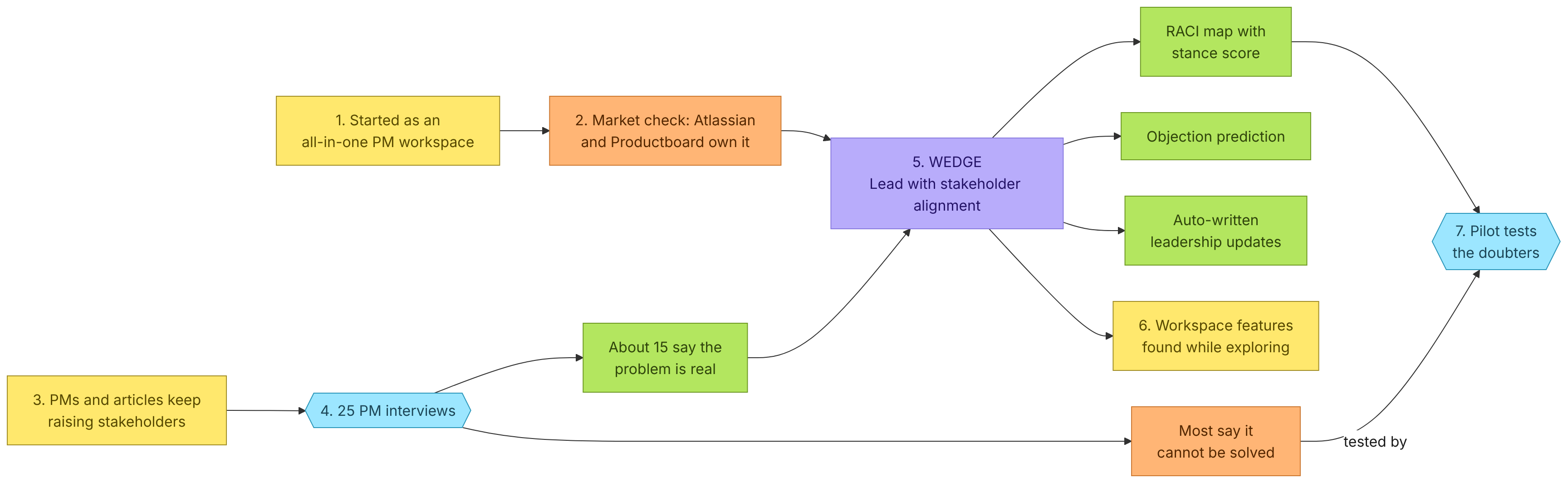

What I'd Do Next
The PMs who said it can't be solved gave me the test. Run the demo with three product teams for four weeks, count how many decisions get reopened before and during, and check whether the sentiment score predicted the people who pushed back. If it doesn't predict anything, I'll know they were right.
A problem everyone agrees on but nobody believes is solvable is either a trap or an opening. The only honest way to find out which is to test it small, with the people most likely to say no.
The full deep dive
For interviewers who want every detail and source.
Where It Started
Knit PM began as an all-in-one workspace for product teams: tasks, research, chat, whiteboard and forms in one place. While talking to PMs and reading about where product work breaks down, one problem kept coming up: stakeholders. I validated it by asking PMs directly.
The market check changed the plan. The all-in-one PM space is already owned by well-funded players such as Atlassian and Productboard, and a newcomer competing head-on would be fighting for a tiny share. But in my research, none of them treat stakeholder alignment as the core job.
The Pivot
One gap kept showing up: no tool owns stakeholder alignment. PMs track tasks in one place and decisions in another, but who actually agreed, who's quietly against it, and who needs to hear what lives in their head. So I repositioned Knit PM around that one job. The workspace features stay, but stakeholder alignment is the front door: people sign up for it, then discover the rest of the product as they explore. It's a wedge strategy: win on the problem nobody owns, then expand into the space the big players own.
What I Built
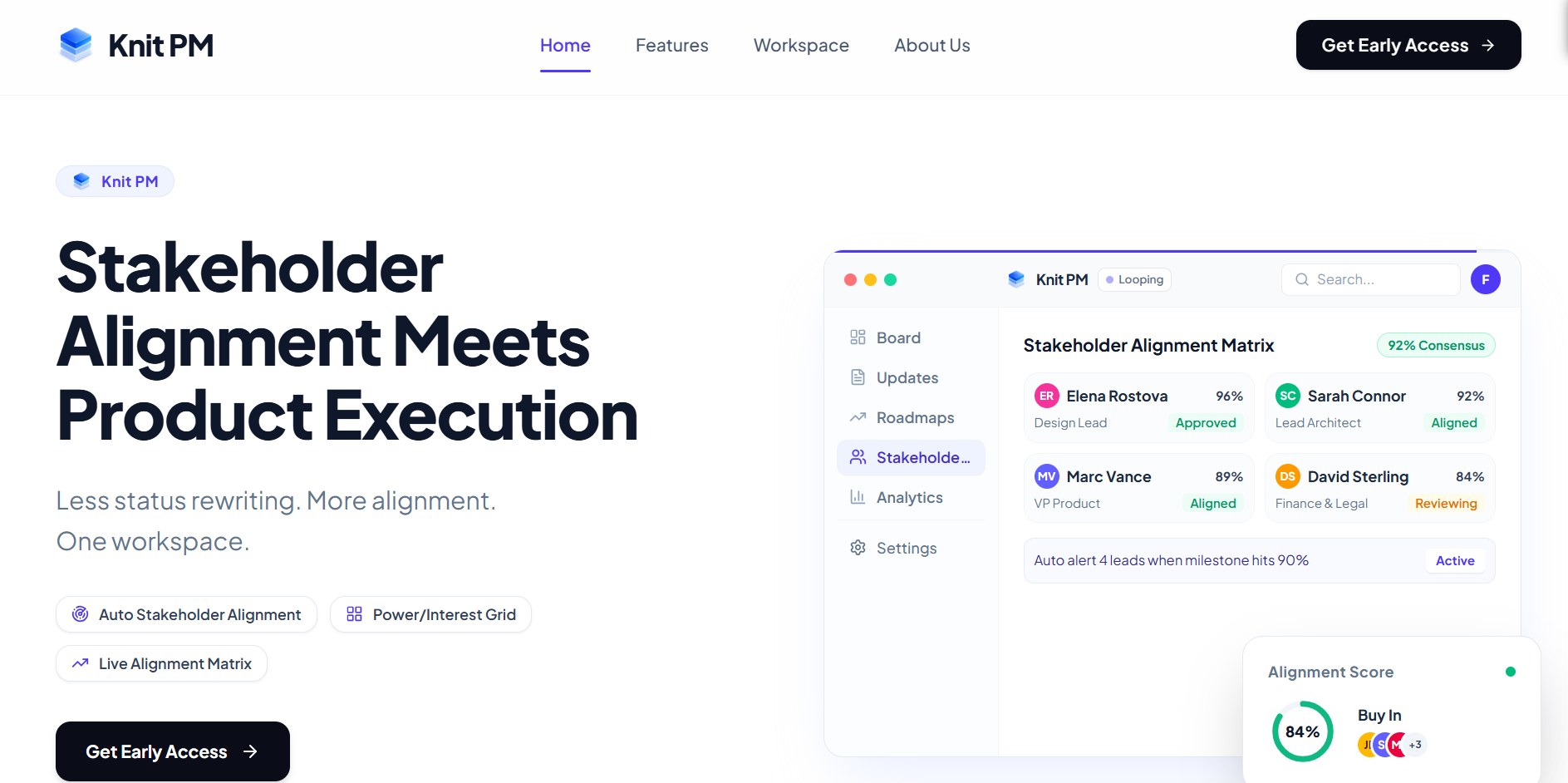
- Stakeholder map: RACI for every decision, with a stance score for each person, set by the PM today and assisted by confirmed signals later.
- Auto-written leadership updates: a status report written from what has actually changed.
- Objection prediction: flags likely pushback before the meeting, not after.
I cut a 32-feature roadmap across 9 categories down to three phases: Core (prove the main value), Moat (what's hard to copy) and Later. I built the demo myself with AI coding tools (Claude Code, Cursor) on React, TypeScript, Node.js, Supabase and Vertex AI.
What 25 PMs Told Me
| Response | Roughly |
|---|---|
| The problem is real | 15 of 25 |
| It can't be solved | most of those 15 |
The objections were specific, which made them useful:
- "You can't change a company's structure." A tool can't give orders to a VP or rewrite who reports to whom.
- "Politics is human, not data." A senior PM put it most sharply: "You can't put office politics in a dashboard."
I think both are true, and neither kills the idea. Knit PM isn't trying to change the structure or replace a PM's judgment. It gives the PM a clearer picture of where each stakeholder stands, so they walk into the meeting ready to persuade instead of being surprised. Whether that picture is accurate enough to help is exactly what the pilot below tests.
PM Deep Dive
Job to be done
When a decision needs sign-off from people who don't report to me, I want to know who's really on board before the meeting, so I don't lose weeks to decisions that get reopened.
Validation ladder: where Knit PM honestly stands
| Stage | Status | Evidence |
|---|---|---|
| Problem exists | Validated | About 15 of 25 PMs confirmed it |
| Solution works | Not yet | Most PMs doubt it can be solved |
| Willingness to pay | Not yet | No paying customers |
The interviews focused on what PMs had actually been through, not what they'd hypothetically want, because past behaviour is a far better predictor than opinions about the future.
Metric tree
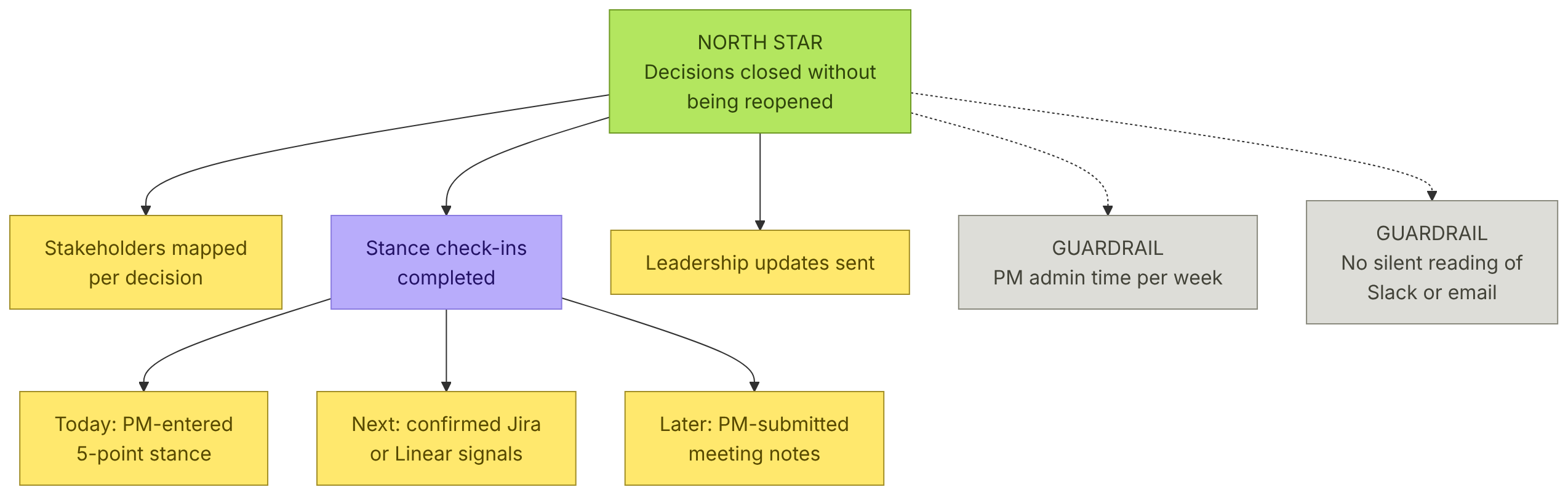
- North Star: decisions closed without being reopened, per team per month.
- Input metrics: stakeholders mapped per decision, sentiment check-ins completed, leadership updates sent.
- Guardrail: time PMs spend in the tool each week. If Knit PM adds admin work, it has failed, however good the insights are.
Prioritisation
The 32 features were sorted into Core, Moat and Later. Within Core, each feature is scored with RICE (reach, impact, confidence, effort), so the first release is the smallest set that proves the main value.
Riskiest assumption test
The whole product rests on one claim: the sentiment score predicts who will push back. In a 4-week pilot with three teams, I'd measure it like a classifier:
- Precision: of the people Knit PM flagged as likely to object, how many actually did?
- Recall: of the people who actually objected, how many did Knit PM flag?
If both are low, the PMs who said it can't be solved were right, and the product needs a different core.
How the stance score works: a trust-first roadmap
| Stage | Signal source | Who decides |
|---|---|---|
| Today | The PM rates each stakeholder's stance on a 5-point scale after every interaction | The PM |
| Next | Suggested signals from Jira or Linear, such as stalled linked tickets or repeated change requests | The PM confirms or dismisses each one; only confirmed signals move the score |
| Later | AI reading meeting notes | Only notes the PM chooses to submit |
| Not planned | Silently reading Slack or email | Ruled out |
Starting manual was deliberate. A wrong, invisible score about a named VP destroys trust faster than having no score at all. Every automated signal arrives as a suggestion with a human in the loop, so the PM can always see why a score changed. Silently reading Slack or email is off the table for three reasons: privacy, accuracy, and the risk of executives finding out they're being scored.
The first version doesn't need to be perfect. It needs to be trusted, and then get smarter with every confirmed signal.